South Africa's Complete Guide to AIR Blowers
The Complete Guide to AIR Blowersin South Africa
Single-stage and double-stage air blowers for pressurised air delivery or vacuum extraction — koi ponds, aquaculture, wastewater treatment, compost tea, and industrial particle extraction. From hobby scale to full industrial.
600mBar Max Pressure
4kWHighest Power Unit
220VSingle Phase
380VThree Phase
Not limited to these specs. The figures above reflect our standard stocked range. We can source single-stage and double-stage blowers in a wide variety of sizes, pressures, and power ratings beyond what is listed — contact us if your application requires something outside this range.
Introduction
What Is aN AIR Blower — and Which Type Do You Need?
We stock single-stage and double-stage air blowers — oil-free machines that push pressurised air into a system, or extract air to create vacuum. Understanding the difference, and what your application demands, is the key to getting it right.
Single-stage blowers pass air through one impeller stage. They deliver moderate pressure at high volume, making them ideal for shallow aeration systems, small aquaculture setups, compost tea brewing, and light industrial extraction — typically below 300 mBar.
Double-stage blowers pass air through two successive impeller stages, compressing further at each step. This enables significantly higher pressures — up to 600 mBar — without sacrificing reliability or flow rate. Double-stage units are the right choice for deeper aeration, large wastewater basins, demanding industrial extraction, and any application where single-stage pressure falls short.
Both types can be configured for positive pressure (blowing) — pushing air through diffusers into water, through ductwork, or into a process — or for negative pressure (extraction/vacuum), pulling air through filters, collection chambers, or separation equipment.
All models operate completely oil-free — clean, uncontaminated air for every application. Available in single-phase 220V for domestic and small commercial sites, and three-phase 380V for larger industrial installations, from compact low-wattage units up to 4kW, with larger sizes available to order.
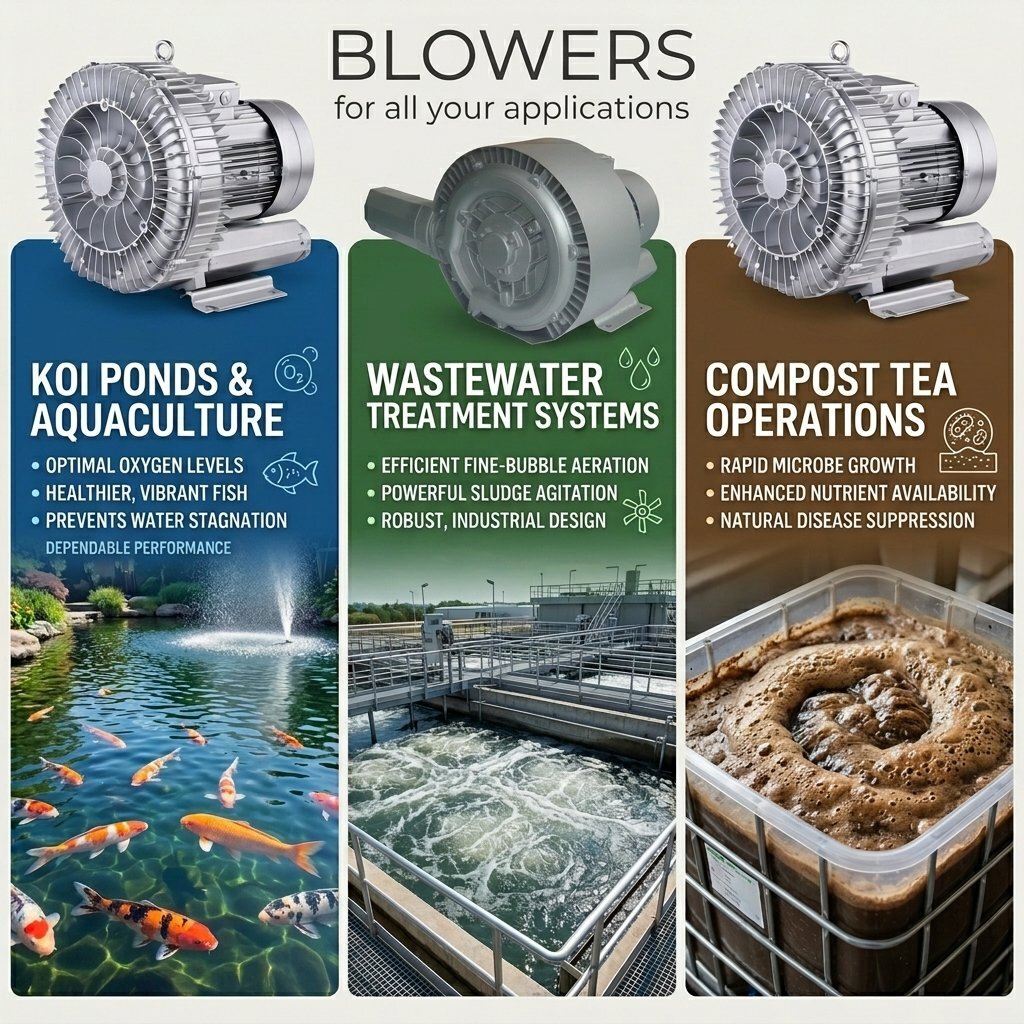
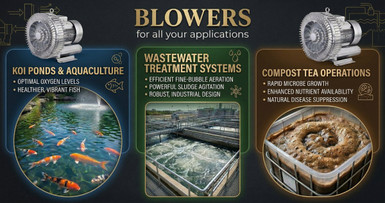
Koi Ponds & Aquaculture · Wastewater Treatment · Compost Tea Operations
Technical Foundation
Understanding Pressure vs. Air Volume Flow
Before diving into specific applications, understand the two defining performance metrics of any blower: pressure (mBar) and air volume flow (m³/hour or litres/minute). Getting these wrong is the most common and costly mistake buyers make.
Air volume flow determines how much oxygen-carrying air is delivered per unit of time. More volume means more oxygen transfer to water, faster composting, or more effective particle extraction.
Pressure (mBar) is the force behind that air — what allows it to overcome resistance from pipe runs, narrow tubing, diffuser membranes, or the weight of water above a submerged diffuser. Without sufficient pressure, the blower cannot push air where it needs to go.
?
The Depth Rule: 100 mBar Per Metre of Water
For submerged diffusers, add 100 mBar of required pressure for every 1 metre of water depth. This is the minimum — it excludes friction losses through pipework, diffuser membrane resistance, and filter pressure drop. Always add a safety margin of at least 50–100 mBar above the calculated requirement.
Example: a 1.5 m pond = 150 mBar hydrostatic + 100–150 mBar margin = blower rated at 250–300 mBar or above.
| Diffuser Depth |
Hydrostatic Pressure |
Recommended Blower Rating (incl. margin) |
Typical Stage |
| 0.5 m |
50 mBar |
150 mBar+ |
Single Stage |
| 1.0 m |
100 mBar |
200 mBar+ |
Single Stage |
| 1.5 m |
150 mBar |
280 mBar+ |
Single or Double |
| 2.0 m |
200 mBar |
350 mBar+ |
Double Stage |
| 3.0 m |
300 mBar |
480 mBar+ |
Double Stage |
| 4.0 m |
400 mBar |
550–600 mBar |
Double Stage — Contact Us |
Application 01
Koi Ponds & Ornamental Water Features
?
Koi & Ornamental
Optimal Oxygen for Healthy, Vibrant Fish
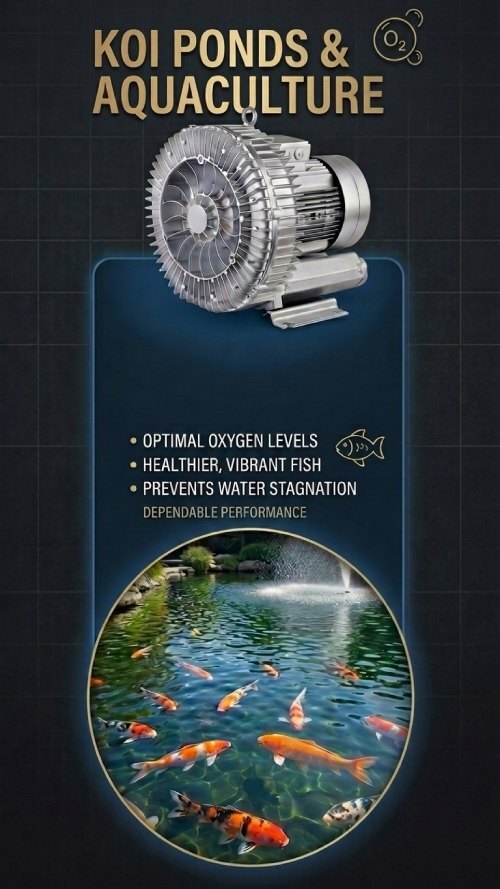
Koi are among the most oxygen-demanding ornamental fish in the world. Dissolved oxygen should remain above 7 mg/L at all times. A correctly sized blower driving fine-bubble disc diffusers at the pond floor is the most efficient way to maintain consistently high DO levels and prevent the anaerobic dead zones that develop without bottom aeration.
- ✓Maintains DO above 7 mg/L threshold year-round
- ✓Eliminates anaerobic bottom zones and reduces ammonia
- ✓Supports nitrifying bacteria in your filter system
- ✓Prevents surface ice formation in cold winters
- ✓Reduces algae growth by limiting CO₂ supersaturation
- ✓Enhances visual appeal with gentle, continuous bubbling
⚠️
Pressure & Volume for Koi Ponds
Most garden ponds are 0.8–1.5 m deep. At 1 m depth: 200 mBar minimum. At 1.5 m: 280–300 mBar. A single-stage blower covers most standard pond depths. Allow 1–2 L/min per 1,000 L of pond volume — heavily stocked ponds may need double this.
Application 02
Commercial Aquaculture & Fish Farming
?
Commercial Aquaculture
Reliable Aeration at Scale — Your Fish Depend on It
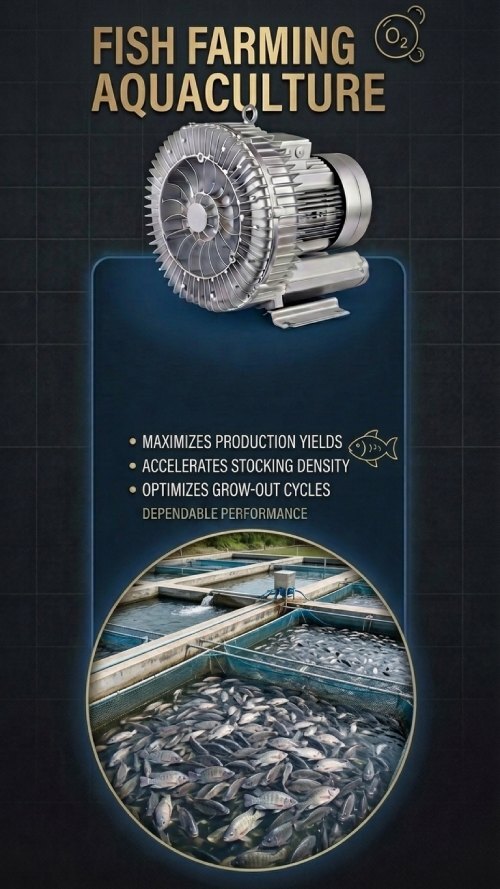
Commercial aquaculture — tilapia, trout, catfish, prawns, abalone — operates at stocking densities that simply cannot be sustained without mechanical aeration. Even a brief oxygen crash causes mass mortality. Oil-free blower airflow ensures zero contamination risk — essential for food-safety compliance — while continuous flow keeps nitrifying bacteria in your biological filters active and efficient.
- ✓Oil-free airflow — zero contamination risk to stock
- ✓Supports extreme stocking densities impossible with surface aeration
- ✓Drives biological filter media aeration in RAS systems
- ✓Three-phase 380V models for large commercial facilities
- ✓Scalable — run multiple diffuser zones from one manifold
- ✓Continuous duty-rated for 24/7 operation
?
Aquaculture Pressure & Volume Sizing
Commercial tanks range 0.8–2.5 m deep. A 2 m deep tank needs 350–400 mBar — typically a double-stage unit. Volume requirements are significantly higher than hobby ponds. For trout (highest DO demand), always size up, not down.
Application 03
Wastewater & Sewage Treatment Systems
?
Wastewater Treatment
Industrial Aeration for Biological Treatment Processes
Biological wastewater treatment relies entirely on aerobic bacteria to break down organic waste. Without adequate dissolved oxygen — maintained above 2 mg/L in the aeration basin — treatment efficiency collapses and your operation risks non-compliance. Fine-bubble aeration through membrane disc diffusers achieves oxygen transfer efficiencies far superior to coarse-bubble or surface aerators.
- ✓Fine-bubble aeration for maximum oxygen transfer efficiency
- ✓Powerful sludge agitation prevents settled solids accumulation
- ✓Robust industrial-grade design for continuous duty operation
- ✓Supports activated sludge, SBR, and MBR treatment processes
- ✓Three-phase 380V models for large municipal treatment works
- ✓Double-stage units handle deep basin pressures up to 600 mBar
⚙️
Wastewater Pressure & Volume Requirements
Municipal aeration basins are typically 3–5 m deep, demanding 400–600 mBar — requiring a double-stage unit. For large basins, multiple blowers running in parallel via a manifold is standard practice. Always add pipe friction margin on top of the depth calculation.

Application 04
Compost Tea Brewing Operations
?
Organic Agriculture
Supercharging Your Soil Biology with Aerated Compost Tea
Aerated compost tea (ACT) is one of the most powerful biological soil amendments available to farmers and viticulturists. Maintaining dissolved oxygen above 6 mg/L throughout the 24–48 hour brew is critical — if oxygen drops even briefly, anaerobic bacteria take over and the brew becomes harmful rather than beneficial. A correctly sized blower is not optional; it determines whether your brew succeeds or fails.
- ✓Maintains DO above 6 mg/L for guaranteed aerobic conditions
- ✓Explosive microbe population growth in 24–48 hours
- ✓Agitation prevents settling and ensures even distribution
- ✓Enhanced nutrient availability and solubilisation in soil
- ✓Natural suppression of soil-borne pathogens and disease
- ✓Reduces dependence on synthetic fertilisers and pesticides
?
Compost Tea: Depth & Pressure Considerations
Standard 1,000 L IBC totes are ~1.0 m deep internally — 200 mBar minimum, comfortably handled by a single-stage blower. Target 100–150 L/min airflow per 1,000 L of brew volume for aggressive agitation and maximum aeration surface.

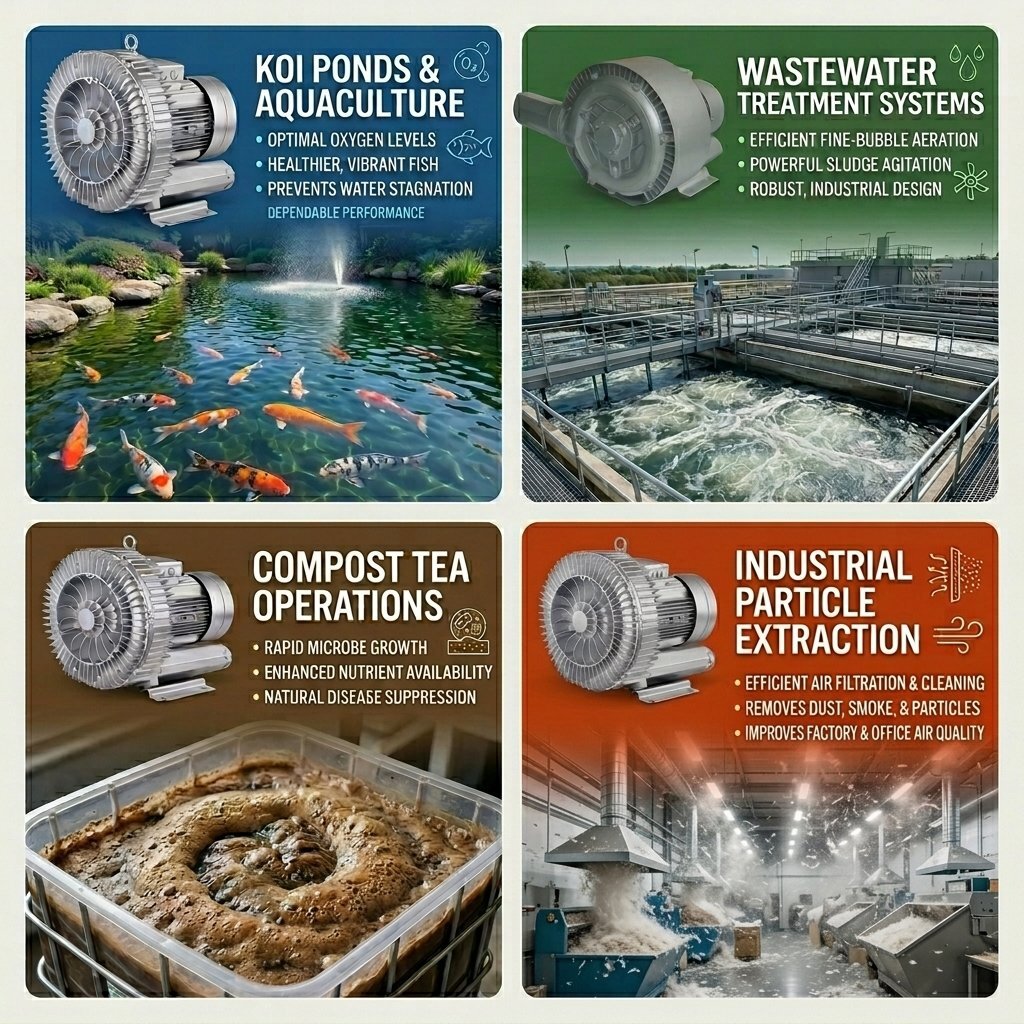
All Four Core Applications — One Range of Single & Double Stage Blowers
Application 05
Industrial Particle Extraction & Air Cleaning
?
Industrial Air Quality
Dust, Smoke & Particle Extraction for Factories and Workshops
In extraction mode, our blowers pull air through ductwork, cyclone separators, and baghouse filter systems. Unlike standard axial fans, single and double-stage blowers maintain performance even as filter media loads up with collected particles — far more reliable for continuous-duty extraction where resistance varies over time.
- ✓Maintains performance as filter media loads — unlike standard fans
- ✓Efficient air filtration across large factory floor areas
- ✓Removes dust, smoke, fumes, and fine particles
- ✓Improves factory and office air quality — OHS compliance
- ✓Suitable for woodworking, metalworking, grain handling, plastics
- ✓Robust three-phase motors for continuous industrial operation
?
Pressure & Flow for Extraction Systems
Medium industrial systems typically specify blowers in the 300–500 mBar range. Always add margin for filter loading. Contact us for custom sizing on large extraction projects.
Our Blower Range
Key Specifications at a Glance
600mBar Max PressureStandard stocked range
4kWMax Motor PowerStandard stocked range
220VSingle PhaseDomestic & small commercial
380VThree PhaseCommercial & industrial
?
Not limited to the above specs. These figures represent our standard stocked range — we can source single-stage and double-stage blowers in a wide variety of sizes, pressures, and power ratings beyond what is listed. If your application requires higher pressure, greater volume, a different power configuration, or a non-standard size, contact us and we will source the right unit for you.
Essential Add-Ons
Blower Accessories: Protect Your Investment
A blower alone is rarely the complete solution. The right accessories protect your equipment, extend its operating life, and ensure your system runs reliably year after year. We stock everything needed to build a complete, professional-grade aeration or extraction system.
Pressure Relief Valves
The single most important accessory you can fit to any blower. Set to open slightly below the blower's maximum rating, it vents excess pressure before it reaches the motor.
Why it matters: Blocked diffusers, kinked pipes, or accidentally closed valves cause sudden pressure spikes. Without relief, the motor absorbs this as heat, rapidly degrading insulation and shortening life. A relief valve costs a fraction of a motor replacement — it is non-negotiable on every installation.
Inline Air Filters
Blowers draw ambient air through their inlet, carrying dust, pollen, insects, and moisture — all of which accumulate on impeller blades and cause premature bearing failure.
Why it matters: An inline filter on the blower inlet protects the impeller and motor from airborne contamination. In dusty farm or workshop environments this is absolutely essential. Even in cleaner environments it remains best practice. Regular cartridge replacement ensures full rated airflow and service life.
Pressure Gauges
A gauge fitted to the blower outlet shows real-time operating pressure — invaluable for commissioning, troubleshooting, and ongoing system monitoring.
Why it matters: Rising outlet pressure over time signals blocked diffusers or filters. A sudden drop indicates a pipe leak or disconnected fitting. Fit your gauge between the blower outlet and the relief valve — you will immediately see if the relief valve opens, giving clear early warning of a downstream blockage.
? Pro Tip — Correct Accessory Order: Install in this order from the blower outlet: Pressure Gauge → Pressure Relief Valve → then your pipework and diffusers. The gauge reads true system pressure; the relief valve protects the motor if that pressure exceeds the safe limit.
Diffusers
Diffusers: Getting the Air Where It Counts
The diffuser converts pressurised airflow into thousands of tiny bubbles that maximise oxygen transfer into water. Choosing the right type and size is just as important as choosing the right blower. We stock a comprehensive range to suit every setup.
Fine Bubble Technology
Disc Membrane Diffusers
The gold standard for oxygen transfer efficiency. The perforated EPDM membrane stretches under pressure, creating thousands of tiny bubbles (1–3 mm diameter) that rise slowly, maximising contact time and oxygen dissolution.
We stock disc diffusers from small 150 mm units ideal for hobby ponds and IBC compost tea totes, up to 300 mm and larger for commercial tanks and wastewater basins. Multiple discs can be manifolded from a single blower.
Best for: Koi ponds, aquaculture tanks, wastewater basins, compost tea brewers.
Key advantage: Highest oxygen transfer efficiency per unit of airflow — saves energy and maximises performance.
Flexible Linear Coverage
Pipe Diffusers
A perforated EPDM membrane over a rigid or semi-rigid PVC or stainless pipe, producing fine to medium bubbles across the entire pipe length. Ideal for rectangular tanks, long basins, and applications needing uniform aeration over a large linear area.
Particularly popular in aquaculture raceways, long rectangular wastewater channels, and large koi pond installations where disc diffusers alone would leave dead zones across the pond floor.
Best for: Aquaculture raceways, wastewater channels, large rectangular ponds, reservoir aeration.
Key advantage: Excellent for long, narrow tanks — easy to install along walls or floors with even coverage throughout.
? Diffuser Maintenance: EPDM membranes develop biofilm over time. Soak in dilute acid or bleach solution, rinse thoroughly, and airflow is restored. Watch your pressure gauge — gradually rising outlet pressure with no other system changes is the most reliable indicator that your diffusers need cleaning.
Buyer's Guide
How to Choose the Right Blower
Selecting the right blower comes down to four questions. Get these right and the selection becomes straightforward.
01
What is the diffuser depth?
100 mBar per metre of depth, plus 100 mBar safety margin. Under 1.5 m = single-stage usually sufficient. Deeper = double-stage required.
02
How much volume flow?
Base on tank volume, stocking density, or basin size. When in doubt, size up — insufficient volume is the most common cause of poor aeration performance.
03
What power supply?
220V single-phase for domestic and small commercial sites. 380V three-phase for larger blowers and industrial use. Contact us if you need higher power on single phase.
04
Which accessories?
Always: pressure relief valve + inline filter. Professional installs: add a pressure gauge. Choose disc or pipe diffusers — or both — based on your tank geometry.
If you are unsure about any of these questions, our team is happy to assist with sizing. We have helped customers across South Africa — from hobby koi keepers in Cape Town to commercial tilapia farmers in Limpopo to wastewater operators in Gauteng. And if your application falls outside our standard range, we will source the right unit. Contact us with your project details and we will get it right.
Ready to Find Your Perfect Blower?
Browse our full range of single-stage and double-stage blowers, accessories, and diffusers — or contact our team for expert sizing advice anywhere in South Africa.
Shop Our Blower Range Get Expert Advice
Nationwide Delivery Across South Africa. We ship to all major centres including Cape Town, Johannesburg, Durban, Pretoria, Gqeberha (Port Elizabeth), Bloemfontein, and surrounding areas. All blowers are CE-certified and come with a manufacturer's warranty. Replacement parts, diffusers, and accessories are held in stock for rapid dispatch.